
Lesotho explores R5-billion floating solar project on its highland reservoirs
The Lesotho Highlands Development Authority is proposing large-scale solar plants on the Katse and Mohale dams
 Add GroundUp on Google
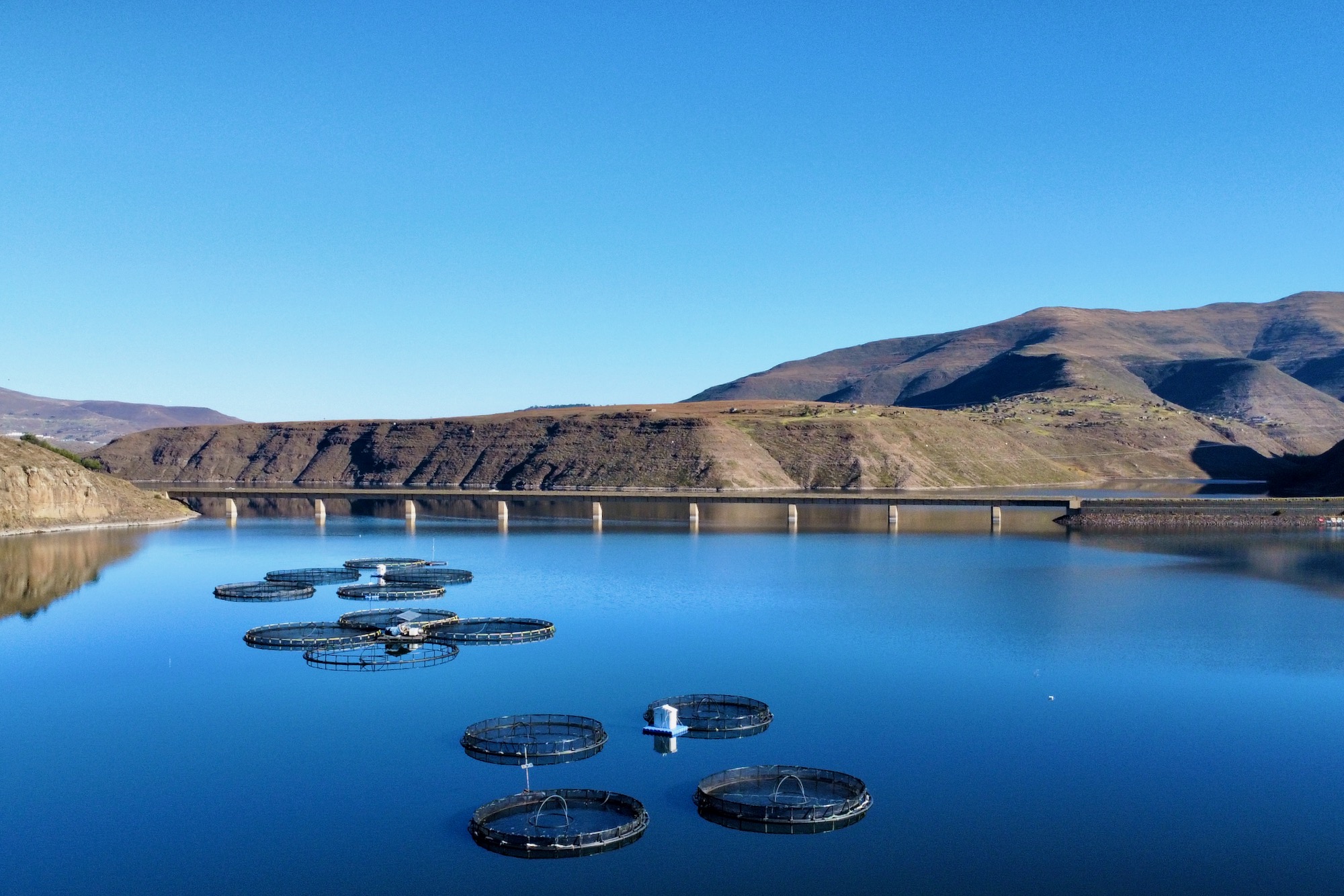
Fish cages floating on Katse Dam. Photo: Sechaba Mokhethi.
- The Lesotho Highlands Development Authority has issued a tender for a feasibility study for large-scale floating solar plants on the Katse and Mohale reservoirs, with preliminary estimates putting the cost at around R4.9-billion.
- Lesotho currently imports nearly half its electricity – 438GWh of the 970GWh consumed in 2024 – mainly from South Africa and Mozambique.
- Floating solar panels would preserve scarce land for agriculture and settlement, and would only use a small portion of the water surface to limit their environmental impact.
Lesotho is considering an ambitious plan to develop floating solar electricity generation on the Katse and Mohale reservoirs. The R5-billion project could reshape the country’s renewable energy future while easing pressure on scarce land resources.
For decades, the dams have supplied water to South Africa and hydropower to Lesotho through the Muela Hydropower Plant. Now, the Lesotho Highlands Development Authority (LHDA) is exploring whether the same reservoirs could also become sites for large-scale solar electricity generation.
A recently issued LHDA tender calls for consultants to conduct a feasibility study for floating solar photovoltaic plants on the two dams. According to the tender, the project could eventually involve power plants ranging between 50MW and 400MW.

The LHDA says the Katse and Mohale reservoirs already have strategic advantages because they are connected to Maseru through existing 132kV transmission lines and roads constructed for the Lesotho Highlands Water Project.
Lesotho struggles to meet domestic electricity demand despite its significant renewable energy potential. According to the LHDA tender, in 2024, the country consumed 970GWh of electricity. Only 532GWh was generated locally, with 438GWh imported mainly from South Africa and Mozambique.
Currently, the country’s largest local power source is the LHDA-operated Muela Hydropower Station, which produces 72MW. Other existing and planned renewable projects include the 30MW Ramarothole Solar photovoltaic plant in Mafeteng; a planned 50MW expansion at Ramarothole; another LHDA proposed 90MW Oxbow hydropower project; a planned 100MW Hirundo wind farm; and several private solar projects.
LHDA spokesperson Mpho Brown said preliminary concept work estimated that a large-scale floating solar development could cost around R4.9-billion. No financing decisions have yet been made, because the project remains at the feasibility assessment stage.
He said possible funding models involve development finance institutions, climate finance facilities, private investors, public-private partnerships, and other renewable energy financing structures.
The floating solar concept would place solar panels on floating platforms anchored on underused reservoir surfaces, preserving land for agriculture, tourism, and settlement.
“Only a small portion of the reservoir area will be used to limit potential negative effects on the environment, particularly on water resources, biodiversity and on socio-economic activities,” the document says.
The project follows positive prefeasibility studies conducted by the Energy Research Centre at the National University of Lesotho (NUL).
The commercial structure of the project remains undecided. According to Brown, future electricity sales could include supplying Lesotho’s domestic grid through the Lesotho Electricity Company, participation in the Southern African Power Pool, or other commercial arrangements.
The initiative appears to signal an expansion of the traditional role of the Lesotho Highlands Water Project, which for decades has focused on supplying water to South Africa while generating hydropower for Lesotho through the Muela plant.
Asked whether South Africa is involved in the project, Brown said it is “primarily being explored as a Lesotho renewable energy development initiative within the broader context of LHDA infrastructure and reservoir assets located in Lesotho”.
The tender document also shows that the reservoirs are increasingly being viewed as economic development zones, including for example aquaculture operations.
The feasibility study procurement process is currently underway, with proposals from consultants expected before the end of June.
Support independent journalism
Donate using Payfast

Don't miss out on the latest news
We respect your privacy, and promise we won't spam you.
Next: Households hire electricity ‘fixers’ after Eskom fails them
Previous: SA murder rate edges down
© 2026 GroundUp. This article is published under the GroundUp Republication Licence Version 1.0. Email [email protected] to request permission to republish.