
Lottery looters must pay back R6-million
Former National Lotteries Commission officials, foundation members and companies diverted funds for a Soweto sports complex that was never built
 Add GroundUp on Google
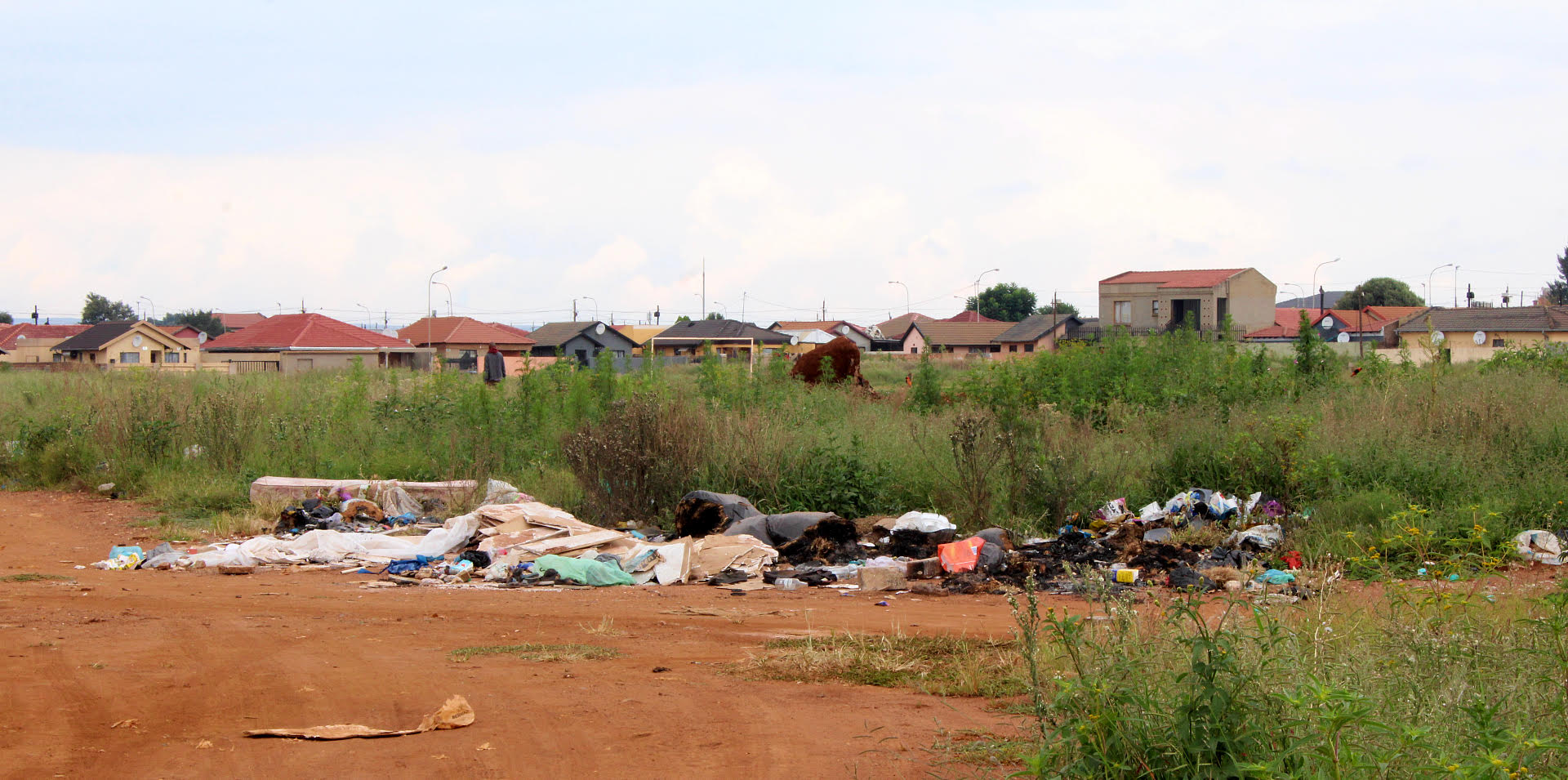
The National Lotteries Commission paid out R6-million for a sports complex in Soweto to be built on this site. The funds were instead diverted for personal gain. Archive photo: Masego Mafata.
- The Special Tribunal has declared a R9-million National Lotteries Commission (NLC) grant for a Soweto sports complex unlawful after finding no construction took place.
- Former NLC officials were criticised for approving funding without exercising their judgment.
- The tribunal judge ruled that R6-million siphoned off to individuals and companies must be repaid with legal costs.
The key players in a R6-million scam in which the National Lotteries Commission (NLC) approved a grant to build a sports complex in Soweto have been ordered to jointly repay the money.
The NLC initially approved a grant of R9-million to Motheo Sports and Education Foundation, but the payment of the final tranche of R3-million was stopped after it was discovered that no work had ever taken place on the site.
The Special Tribunal has now declared the 2021 award of a grant unlawful and invalid. The grant was allocated in terms of the NLC’s “proactive funding” policy, which became a key mechanism for wide-spread looting.

Judge Andre Petersen has ruled that several individuals, their companies and former NLC officials must repay R6-million, and pay the legal costs of the Special Investigating Unit (SIU).
Among them is Marubini Ramatsekisa, who was employed as the NLC grant funding project manager. He prepared the proactive funding proposal recommending that Motheo receive R9-million to construct the Protea Glen Sports Complex.
The proposal was approved on the same day by Nkheso Njoni, then acting Chief Operations Officer.
Acting on that authority, the NLC quality assurance committee approved the R9-million funding and agreed that the money would be paid in three tranches, each conditional upon proof of progress on the project.
Motheo, a non-profit foundation, was effectively controlled by Petrus Sedibe and Nonhlanhla Matshazi. Sedibe was also the sole director of a company called PSKO and Matshazi controlled another company, Londilox.
Judge Petersen said the evidence showed that after the first R3-million was transferred, substantial amounts were then transferred to Londolox, PSKO and other entities.
In January 2022, Sanele Dlamini joined the NLC as senior manager of grant operations, taking over from Ramatsekisa.
The next month, he approved a second tranche of R3-million.
More than R2-million of this was transferred to Sedibe’s personal Capitec bank accounts.
Judge Petersen said disciplinary proceedings had been initiated into Dlamini’s conduct and he had been dismissed. In December 2024, the tribunal had granted an urgent interdict, preserving his pension.
Before Judge Petersen, Dlamini denied acting dishonestly. He said that he relied on documentation that had already been processed internally and that he could not have been reasonably expected to detect sophisticated fraud without forensic tools.
The judge said he accepted that Dlamini was entitled to attach weight to the endorsements of other officials, “but the progress report before him contained irreconcilable internal consistencies, apparent on its face.”
“The narrative that earthworks were in progress and fencing had been procured while the site photographs depicted open, undeveloped land was inconsistent.
“He also did not visit the site before authorising payment, a step that would have required no forensic tool.
“He was not a whistleblower, as he postulates. Recovery was recommended in March 2023 by the then acting provincial manager [of the NLC] not Dlamini.”
Mmamadumo Dorah Maodi, another NLC employee who had prepared a standard checklist at Dlamini’s direction and signed it as a reviewer without reading it, had claimed she was just performing her administrative duties.
However, the judge said her “position is not as clear” as she contended, because she had a business association with Sedibe – a conflict of interest which she had not disclosed.
Ramatsekisa, opposing the SIU application, claimed he had acted on instructions from the former acting chief operating officer. But, Judge Petersen said, that did not answer the point.
“Public officials entrusted with statutory powers remain under a duty to ensure that those powers are exercised lawfully. He [Ramatsekisa] was paid to exercise independent professional judgment. ”
The judge said he had no credible basis to identify Motheo as a suitable beneficiary.
Njoni, who had approved Ramatsekisa’s proposal on the same day it was drafted, had also failed to exercise the independent judgment required of his position.
Regarding Sedibe, the judge said he was the principal beneficiary of the “corrupt scheme”.
Sedibe and PSKO had elected to abide by the decision of the tribunal and had not advanced any version in opposition.
Matshazi, he said, was the “co-architect” of the scheme with Londilox, having received R500,000 from the first tranche “without any evidence of services rendered”.
Tebogo Mohlala, who executed the grant agreement on behalf of Motheo, had filed an answering affidavit consisting of only “bare denials”.
Mohlala, Sedibe and Matshazi were jointly liable for the diversion of funds, evidenced by Motheo’s bank account which reflected that they had authorised withdrawals of more than R1.6-million through teller cash and ATM withdrawals and purchases, spanning both the first and second grant payments.
“No evidence has been produced that any part of this was used towards the construction of the sports complex,” Judge Petersen said.
Two other companies, Synercon and 2MC Consulting, which had also received money from Motheo following the grant payments, were also held liable.
Support independent journalism
Donate using Payfast

Don't miss out on the latest news
We respect your privacy, and promise we won't spam you.
Next: Auto strike will set a precedent, says union
Previous: Budget cuts, bureaucracy and payment delays put Gauteng’s most vulnerable at risk
© 2026 GroundUp. This article is published under the GroundUp Republication Licence Version 1.0. Email [email protected] to request permission to republish.