
Paraplegic man finally gets care after years of legal battles with government
Paul Gerber, 58, lived in a wooden shed with no ablutions in Kalbaskraal while the state contacted 173 facilities on his behalf without success
 Add GroundUp on Google
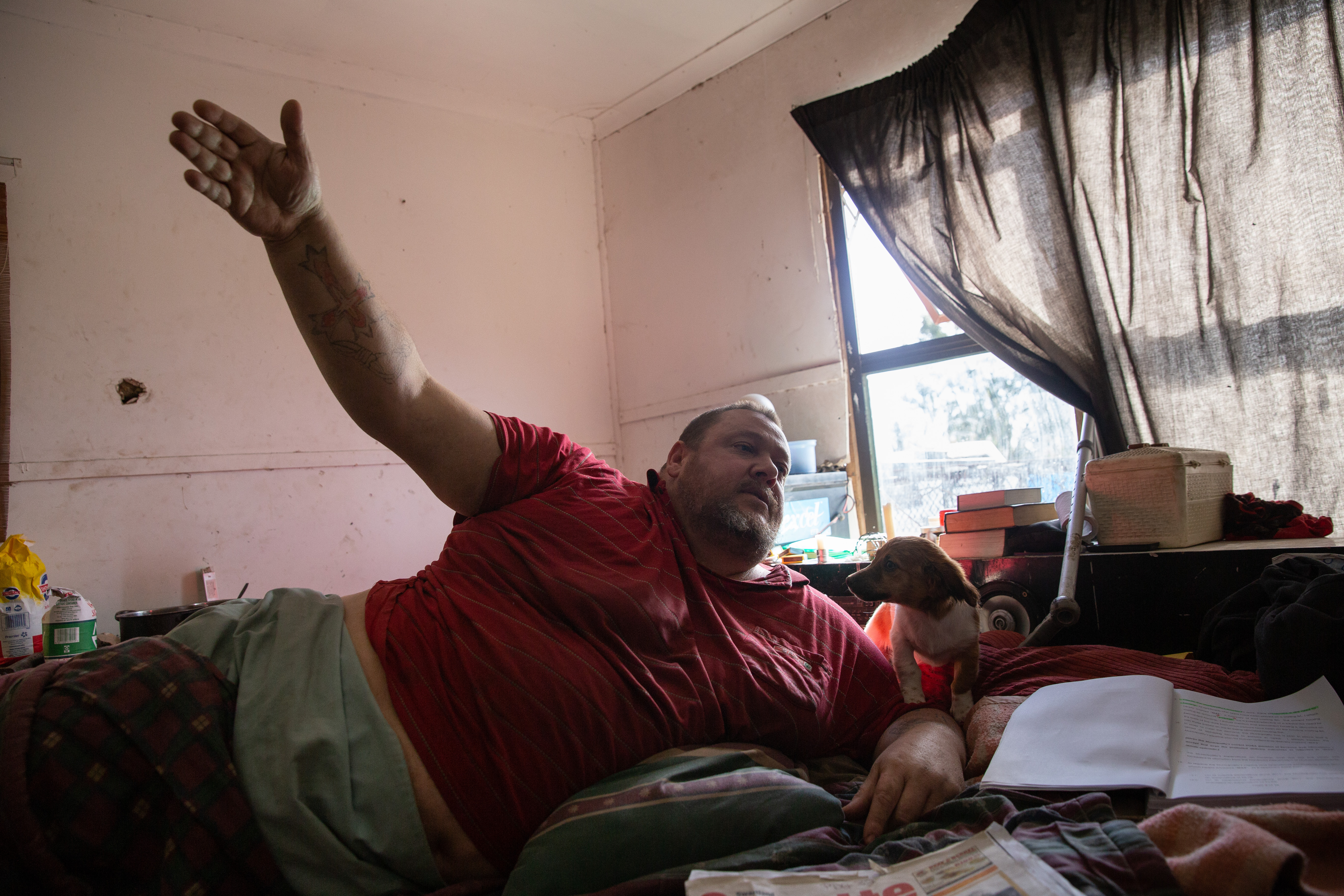
Paul Gerber when GroundUp reported on his predicament in 2018. Archive photo: Ashraf Hendricks
- Paul Gerber, a paraplegic with morbid obesity and uncontrolled chronic diseases, has finally found a place at Turfhall Cheshire Home after two and a half years of legal battles with the Western Cape Department of Social Development (DSD).
- The department contacted 57 disability facilities and 116 old age homes without a single successful placement; 104 did not even respond.
- Gerber’s lawyers said this was “an indictment on the DSD” and that merely sending applications could not absolve the state of its constitutional obligations
- A high court judge ordered the department to appoint a social worker to assist Gerber within 21 days.
In a case that involves the constitutional obligations of the state and government-funded care facilities, a 58-year-old paraplegic man, who has morbid obesity and uncontrolled chronic diseases, will finally be given the care he needs.
Paul Gerber was living in a wooden shed with no ablutions on land awarded to him by the Swartland Municipality in Kalbaskraal. Gerber, and his lawyers from Legal Aid South Africa, battled for two and half years with social development authorities for his right to be accommodated in a suitable state facility.
In 2021, after acknowledging that he was in need of 24-hour care, he was driven 200km to Sederville Home, but he was turned away, apparently because the facility did not have a bed big enough for him nor male nursing staff to assist. He was told, “Go back to your plot.”

In February this year, Western Cape High Court Judge Constance Nziweni ordered the Minister of Social Development and the MEC for social development to appoint a social worker within 21 days to assist Gerber to complete all the required applications for residential care and to fulfil his right to be accommodated in a suitable state facility. The department agreed.
Judge Nziweni said she would personally manage the matter going forward.
On 6 May, he was finally placed at Turfhall Cheshire Home.
“It has been a two-and-half-year-long battle,” Legal Aid SA said. “We are pleased with this outcome”.
GroundUp reported on Gerber’s plight in 2018, when he was facing eviction from another, privately owned wooden house he was renting in Kalbaskraal.
He told GroundUp that he suffered a spinal injury when he and his two employees were attacked and robbed by five men in 2012. He subsequently lost his business, his house, and almost everything he owned.
In written argument, which came before Judge Nziweni, the department said it had been trying since September 2021 to place Gerber. It said it sent out requests to 57 facilities catering for people with disabilities and 116 old age homes, without a single successful application.
It further argued that housing was not its responsibility, and that it did not operate its own residential care facilities but only provided funding for them.
However, Gerber’s lawyers, in their written submission, said this pointed to an “unmitigated failure to exercise proper oversight”.
“Alarm bells should have been ringing,” they said.
“104 (facilities) did not even respond to the DSD and of those who responded, the reason for the unsuccessful application was that the applicant did not meet the criteria or there was no bed space available. This is an indictment on the DSD.
“Merely sending off applications cannot reasonably be said to absolve the DSD of its constitutional obligations.”
The department argued it was assisting Gerber through a social grant and a grant-in-aid. But his lawyers said it was focussing on the provision of grants “to the detriment of other forms of assistance”.
His lawyers submitted that the department had mischaracterised Gerber’s plight as a “housing issue” and did not consider him to be “homeless”, because the municipality had awarded him the small, unfenced, uneven plot on which he had built a wooden shack.
“There can be no question that his human dignity has been impaired. The DSD seems now to question the veracity and severity of his condition, not only drawing into question his integrity but also minimising the seriousness of his condition.
“He is unable to manage his medical condition, does not receive needles for his insulin, does not have access to adequate meals and cannot use public or ordinary transport to seek medical attention. He is entirely dependent on others to meet his basic needs,” they argued.
While discrimination against people with disabilities was not a novel phenomenon “there appears to be a void in legislation with regard to effective management and prohibition of discrimination against people based on weight”, they submitted.
Support independent journalism
Donate using Payfast

Don't miss out on the latest news
We respect your privacy, and promise we won't spam you.
Next: Schools left in darkness as municipal bills mount
Previous: In photos: Cape storm wreaks havoc
© 2026 GroundUp. This article is published under the GroundUp Republication Licence Version 1.0. Email [email protected] to request permission to republish.