
SASSA at 20 years: 73% of pensioners receive the old age grant
Grant has helped reduce poverty, but it is being stretched to maintain households
 Add GroundUp on Google
This is the second in a short series looking back over 20 years of SASSA.
Nearly three in four older people in South Africa receive an old age grant. Researchers say the grant has helped reduce poverty among older people, but it is being stretched by rising living costs and growing care needs.
Currently valued at R2,400-R2,430 a month, the grant is being used not only to support older people, but also to feed extended families and cover transport, healthcare and other household expenses.
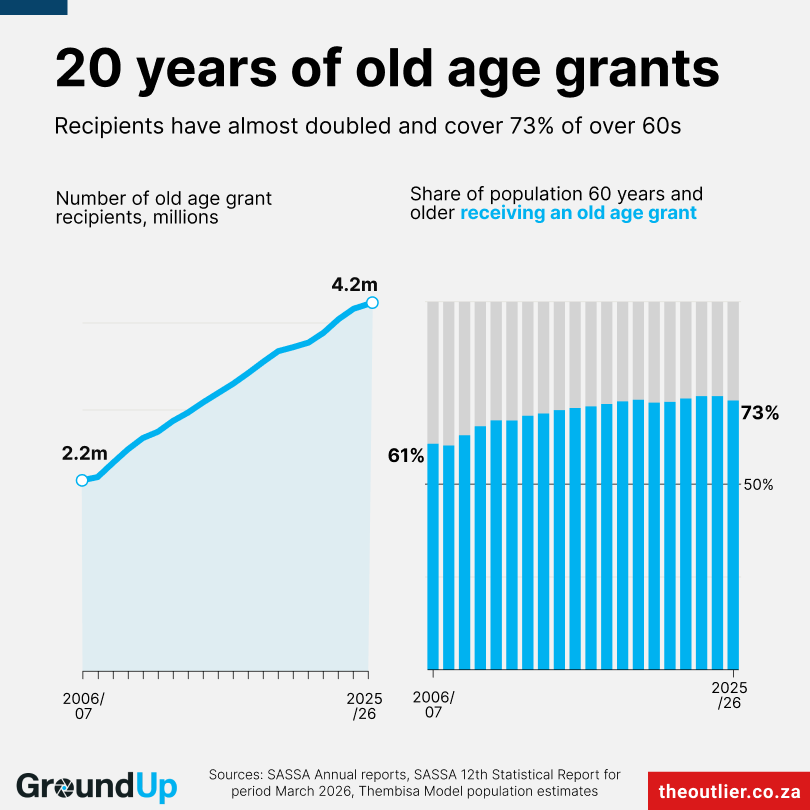
Over the past 20 years, since the establishment of SASSA, the number of beneficiaries of the grant has increased substantially. In 2006, 2.2-million, or 61% of the over-60 population at the time, received the grant. Today, 4.2-million, about 73% of the over-60 population, receive it (using population estimates from the Thembisa model).
The number of grant recipients has grown faster than the older population, partly because, until 2010, men only became eligible for the grant at 65.
In 2006, the grant was R820 a month. Today it is R2,400 for people aged 60 to 74 and R2,430 for those 75 and older. That is roughly what R820 would buy today, so the grant has kept pace with inflation - but only just. 
The government spent R21.2-billion on the grant in 2006/07, and R115.8-billion in 2025/26. Adjusted for inflation, R21.2-billion in 2006 is worth about R62-billion today. That means real spending has almost doubled.
The old age grant is available to people aged 60 and older who earn less than R9,350 a month and own less than R1.6-million in assets.
The system has changed significantly since its origins. Old Age Pensions were first introduced in 1928, initially for “white” and “coloured” people. They were extended to “Indian” and “Black African” people in 1944, although people of colour received less money. In the 1980s, the value of the pension for black pensioners was raised while the white pension was reduced. By 1994 the grant amounts for all groups were the same.
Before SASSA was established in 2006 to administer social grants nationwide, the nine provincial governments were responsible for this, often using private payment contractors.
A bigger safety net
Poverty rates among people aged 60 and older fell “across all three national poverty lines between 2006 and 2023”, according to Stats SA.
The share of older people living below the upper-bound line, below which a person can’t afford the minimum food and non-food essentials, fell from 74% to 53%.
On the lower-bound line, where people must choose between food and other essentials, it fell from 53% to 26%.
The share below the food poverty line fell from 23% to 11%.
In 2024, grants were the main income source for 60% of older-person-headed households, followed by salaries, wages or commission, according to Stats SA.
Research by the University of Cape Town’s Family Caregiving Programme, published in 2025, found that older people in low-income households often use their grants to cover food and other household expenses. The poorest families have to stretch their resources “further across more kin”.
In these households, there is “every day sharing of resources which is essential for survival”, and the grant becomes “the key source for household expenditure, most importantly food”.
But the grant is “not elastic”, and older people often have to take out loans to cover food costs. For people with disabilities or specific care needs, the cost of private transport and incontinence products can “erase any benefit derived from the state pension”.
The monthly cost of nutritious food for a family of seven was about R6,700 in June 2026, according to the Pietermaritzburg Economic Justice and Dignity household affordability index.
But Family Caregiving found that low-income households headed by older people often spend far less on food than needed for a nutritious diet, as household resources are stretched across competing expenses. Food is “the essence of survival and essential for healthy ageing, yet it is the item that is most sacrificed and reduced when money is tight”, the report said.
In Stats SA’s 2022/23 survey, about 87% of older people said they were satisfied with SASSA. Among those who were dissatisfied, about a third said it was because the grant money was not enough.
Pensioners have held several protests over the years calling for the grant to be increased. Last year, Western Cape pensioners told Parliament the grant does not cover food, rent, electricity and other essentials. They asked to raise the grant to R5,000 a month, and to increase it by at least 6% every year.
Family Caregiving suggests that increasing the grant remains one of the main requests from older people and their caregivers. But many caregivers also wanted a separate grant for the work they do. They said it would also take pressure off the old age grant. Others asked for more food support, home-based care, and better access to housing, toilets and medication.
Without family or formal support, the researchers said, caregivers are “overstretched, exhausted and depleted”.
Support independent journalism
Donate using Payfast

Don't miss out on the latest news
We respect your privacy, and promise we won't spam you.
Next: Khayelitsha brothers turn invasive hyacinth into biochar business
Previous: Violence and mayhem in Durban anti-immigrant march
© 2026 GroundUp. This article is published under the GroundUp Republication Licence Version 1.0. Email [email protected] to request permission to republish.