
Fed-up residents grab brooms and shovels to fix their town
“We need to work together to get the town back in shape and be proud of it”
 Add GroundUp on Google
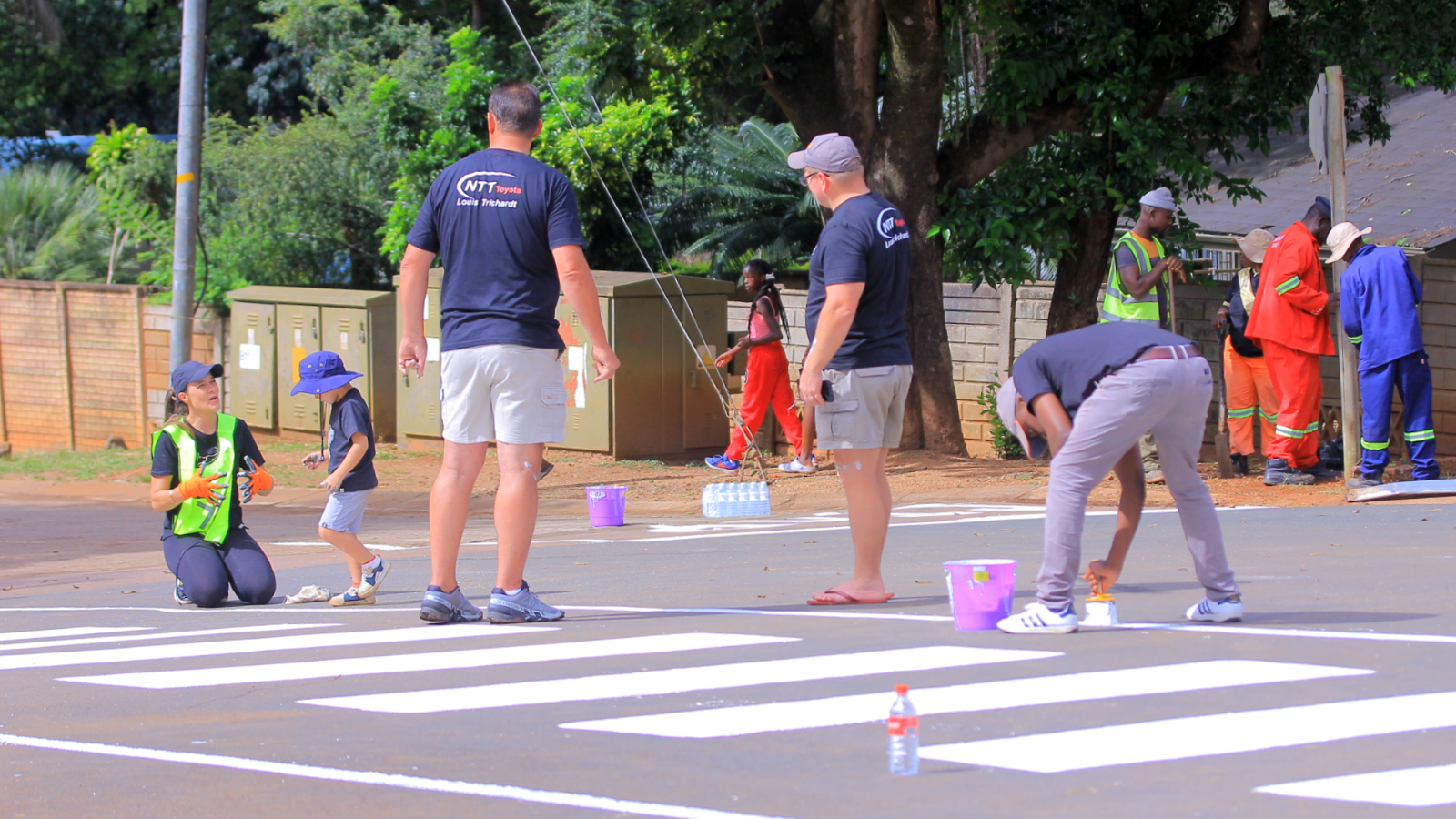
Volunteers paint road signs during Saturday morning’s campaign in Louis Trichardt. Photo: Thembi Siaga
- Residents of Louis Trichardt cleaned up the town’s streets on Saturday.
- This was an initiative of local businesses but people from all walks of life participated.
- Organisers plan to formalise the initiative and engage further with the municipality.
When residents are fed up with a lack of service delivery, some take to the streets in protest. Some wave placards and others even resort to setting buildings alight. In Louis Trichardt, however, residents took to the streets with refuse bags, paintbrushes and shovels.
On Saturday, 18 April, the normally quiet town just south of the Soutpansberg mountain was bustling with activity. Residents from all walks of life cleaned overgrown sidewalks, painted road signs and pruned tree branches to improve visibility. Businesses contributed machinery to help fill potholes, re-erect road signs and even repair streetlights that were not working.
The initiative was organised by members of the local business community, who said the condition of parts of the town had deteriorated to the point where intervention could no longer be delayed. It was a spur-of-the-moment action, but the outcome exceeded expectations. Hundreds of residents, including learners from local schools, supported the initiative.
“We are always complaining about the state of the town, but we are not doing anything about it,” said Renier Fourie, one of the organisers. “We need to work together to get the town back in shape and be proud of it.”
He emphasised that the action is not political and not in opposition to the local municipality, whose responsibility it is to carry out such work. For that reason, the municipality was kept informed of the plans and agreed to be present.

Mehul Patel, another businessman who formed part of the organising team, said the initiative grew out of frustration among a small group of business owners. “This is our town, our responsibility,” he said. “About 11 of us sat down and said we can’t just watch things fall apart.”
He said they initially created a WhatsApp group to involve other businesses. “It quickly grew to about 520 people. From there it spread.”
Support from all sectors
The initiative drew strong support from across the community; people and businesses who could not contribute labour or equipment offered financial support.
The town’s mayor, Dorcus Mboyi, also made a brief appearance, where municipal workers were working alongside private contractors to repair part of Munnik Street, one of the town’s main arteries.
Mboyi said the day showed the importance of co-operation. “We must work together, [as] business, community and municipality, to improve our town,” she said. She added that further discussions would follow between the municipality and organisers.
The following day, in a message on social media, she said businesses, like the municipality, have a vested interest in a safe and well-maintained environment. She expressed optimism that this co-operation could be further developed.
Limpopo Premier Phophi Ramathuba visited Louis Trichardt on Saturday afternoon to show support for the initiative. At a meeting in town, she emphasised the importance of continued collaboration to improve service delivery.
But the true heroes of the day were the many residents who turned up with brooms, shovels or simply refuse bags to help clean the town.
“We want people to take responsibility, and we want young people to understand why it matters,” said resident Morné Brandt. “It takes effort to maintain a town.”
A hawker, Sheron Nkanyani, said she was pleased to see the town being cleaned. “The town was dirty. We hope it stays clean from now on. Let’s be united and keep it clean,” she said.
Some participants viewed the day as an educational opportunity. “We want to teach our children why it is important not to throw papers out of the window. It takes hard work to keep the town clean,” said local teacher Carla Lottering.
But where to from here?
Mehul Patel said Saturday’s clean-up was not a once-off event, but part of a broader initiative aimed at cleaning the town, fixing what is broken and encouraging co-operation among all stakeholders.
Patel added that the organising committee will now meet to review the weekend’s activities. He said they plan to engage further with the Makhado Local Municipality on possible collaboration. “We will sit down again and see how the municipality can recognise this effort. We will take it forward from there.”
Another member of the organising committee, local attorney Johann Hammann, made his firm’s trust account available so that all donations can be managed transparently.
Hammann said that the first step is to formalise the structure. There are currently 11 members, mainly from the business sector, forming a planning committee. The next step would be to establish a non-profit organisation.
One of Saturday’s biggest achievements may have been the opening of communication channels between residents, the business community and the local municipality. The time may now be right to enter into a formal memorandum of agreement with the Makhado Municipality.
Municipalities can join hands with residents
Although not common in Limpopo, there are examples where residents and the local business community pool resources and work together within a legal framework.
Roads, streetlights and similar infrastructure fall under the definition of basic municipal services in terms of Section 73 of the Local Government: Municipal Systems Act. Because municipalities own this infrastructure, any work done on it without permission is legally grey.
There is also the issue of liability. Community members who carry out repairs without authorisation could expose themselves to damages claims. If repairs are not done correctly and result in injury or damage, the claim would be against the person who carried out the work, not the municipality.
Residents’ associations can apply for formal wayleave permits from a municipality. This provides written permission to work in the road reserve and establishes a legal basis for such work.
In provinces such as the Western Cape, residents have formed City Improvement Districts (CIDs) or Special Rating Areas (SRAs).
CIDs are governed by Section 22 of the Municipal Property Rates Act, the Companies Act (as non-profit companies), the Constitution and relevant municipal by-laws. Property owners contribute additional rates to fund supplementary municipal services within a defined area, based on a community-supported business plan approved by council.
This does not exempt the municipality from delivering services in those areas. The municipality remains obligated to provide basic services, while the CID delivers additional support.
Support independent journalism
Donate using Payfast

Don't miss out on the latest news
We respect your privacy, and promise we won't spam you.
Next: South Africa and Lesotho agree that IDs will be enough to cross the border
Previous: Labour Court slams CCMA commissioner who questioned assault victim’s gender
Letters
© 2026 GroundUp. This article is published under the GroundUp Republication Licence Version 1.0. Email [email protected] to request permission to republish.