
Government admits it unlawfully withheld billions from schools
Withholding billions of rands from public schools was unconstitutional, but the schools won’t get the money back
 Add GroundUp on Google
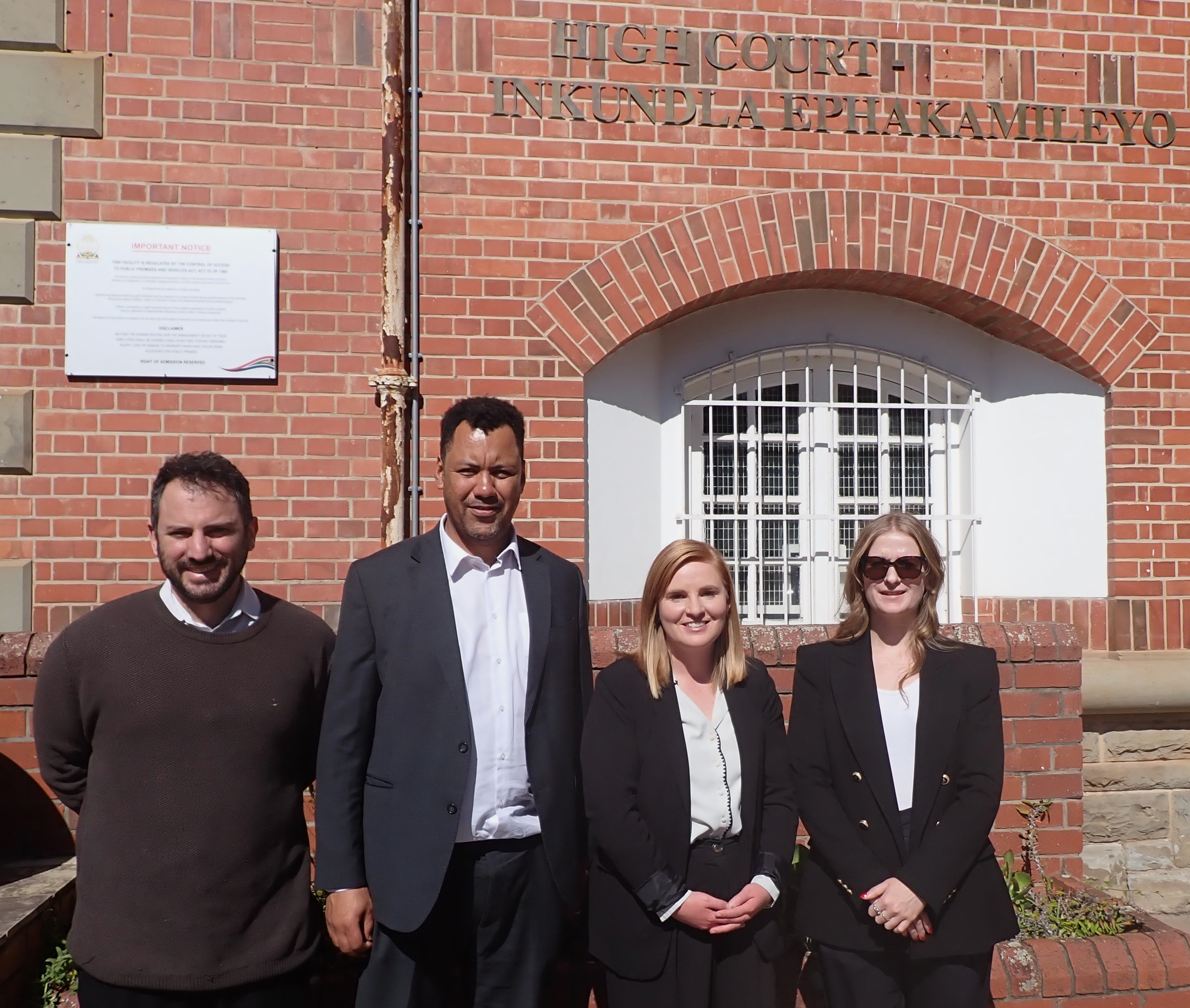
The LRC legal team that successfully represented the Makhanda Circle of Unity, with the governing bodies of three Makhanda schools, in their case against the Eastern Cape Department of Education. From left: Daniel Linde, Michael Mbikiwa, Cecile van Schalkwyk and Claire Rankin. Photo: Gcina Ntsaluba
- The Eastern Cape Department of Education has conceded in court that withholding several billion rand from public schools since 2020 was unlawful.
- The case was brought by Makhanda Circle of Unity with the governing bodies of three schools.
- About R6-billion has been held since 2020, according to calculations.
- But in terms of the agreement, which was made an order of court, the schools will not get the money back.

The Eastern Cape Department of Education (ECDoE) admitted in the Makhanda High Court on Wednesday that it was unlawful and unconstitutional to withhold billions of rands from public schools. But the schools will not get the money back.
The case emanates from a 2020 decision by the ECDOE to deviate from the per-learner school allocation target that schools receive as part of their yearly budget. About R6-billion has been held since 2020, according to calculations.
The case was brought by the Makhanda Circle of Unity along with the governing bodies of Ntsika Secondary School, Hoërskool PJ Olivier and Tyantyi Primary School, represented by the Legal Resources Centre (LRC). SECTION27 was admitted as amicus curiae. The parties reached an agreement which was made an order of court.
Under the order, the decision to withhold part of the schools’ budget was declared unconstitutional. The ECDoE must give every Eastern Cape school its full allocation for the 2027/2028 financial year, based on the prevailing minimum per-learner target. The department must also report on compliance at intervals until September 2027.
About R6-billion
The ECDoE has withheld roughly R6-billion from no-fee schools between 2020 and 2026, according to calculations. The figure was estimated at R5-billion last year, but has kept growing while the case waited to be heard.
The Minister of Basic Education has gazetted a target of R1,835 per learner for 2026 for no-fee schools in quintiles 1 to 3 for the current financial year. But the Eastern Cape department has been transferring R1,101, a retention of 40%.
Across roughly 1.58-million no-fee learners in the province, about R1.16-billion has been withheld in the current financial year alone, bringing the total since 2020 past R6-billion.
None of it will be repaid. The applicants had asked the court to direct the department to return funds withheld from schools. But the order does not provide for that — the department conceded that its conduct was unlawful but kept the money.
Toilet paper and disconnected water
In a statement issued on the eve of the hearing, the LRC set out what the shortfall looks like inside schools. Parents already surviving on child support grants have been asked to supply toilet paper, cleaning products and copying paper. Teachers and principals have bought stationery and textbooks out of their own pockets. Some schools have had their water and electricity disconnected because they could not pay their municipal accounts.
In its own court papers, the department says some of the money it retained from schools (R834-million in 2023/2024) was used to bail out schools that had defaulted on municipal services. The ECDoE, in other words, held back a third of every school’s operating budget in part to rescue schools that could not pay their bills.
“A slap in the face of every child in this province”
Speaking outside court, Cecile van Schalkwyk of the LRC described a resounding victory undermined by the time it had taken to achieve it.
“To come to court on the day of the hearing and say sorry, now we accept that the argument you have made all these years is true and correct, while schools have been losing out for a very, very long time. I think it is just a disgrace,” she said.
Van Schalkwyk said the case concerned two distinct categories of unlawful conduct.
The first was the decision to cut the per-learner allocation in 2020/21 and 2021/22 without the joint planning process which the National Norms and Standards for School Funding require, a plan that the department was obliged to devise with National Treasury and the national education department to bring funding back to target.
The second was the continuing practice of funding schools at the target rate on paper while retaining a share under the heading “provincial norms and standards”, a line item that appears nowhere in the funding norms, and which the ECDoE has never explained in its court papers.
“It is not us who have suffered. It is the children who, for the last three years, have not had the benefit of the full financial support they were due,” she said. “It is a slap in the face of every single child in this province.”
“Two pens for the whole year”
“The stationery funding was kept as cheap as possible,” said Priscilla Glover, former principal of Tantyi Primary School.
“They would only provide two pens for the year. A child needs four pens, one for every term. So either the teachers are buying the pens, or the principals are buying the pens, or the parents are buying the pens, or the child is not getting a pen,” Glover said.
She said the allocation was already insufficient before the department started withholding money, with basic operating costs such as banking and audit fees not covered, yet legally required for a school to function.
“They are so strict about schools following financial guidelines, yet they cannot follow their own ring-fencing structures,” she said. “And the way it is put in the budget is in very complicated jargon. Each person does not even understand why.”
“If this decision had been made in 2023, schools would have benefited in 2024, 2025 and 2026. Now they are only going to benefit from 2027,” Glover said.
Costs were awarded against the respondents, who include the Minister of Basic Education, the national Minister of Finance and the Eastern Cape MEC for Finance, Economic Development and Environmental Affairs.

Support independent journalism
Donate using Payfast

Don't miss out on the latest news
We respect your privacy, and promise we won't spam you.
Next: Sugar workers down tools
© 2026 GroundUp. This article is published under the GroundUp Republication Licence Version 1.0. Email [email protected] to request permission to republish.