
Fewer people are being convicted for commercial crimes
The NPA’s Specialised Commercial Crimes Unit is underperforming
 Add GroundUp on Google
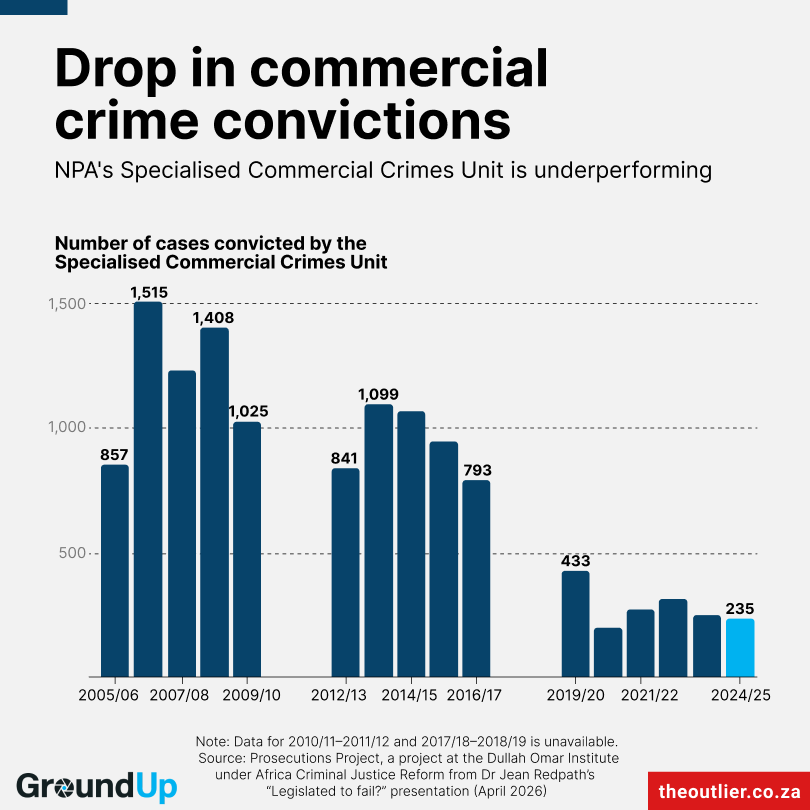
The number of people being convicted of commercial crimes has dropped significantly in the past two decades, while the number of reported crimes has increased.
The National Prosecuting Authority has a dedicated unit – the Specialised Commercial Crimes Unit (SCCU) – to prosecute fraud, corruption and money laundering.
In addition to the prosecuting unit, South Africa also has Specialised Commercial Crime Courts (SCCCs). Most of the SCCU’s cases are prosecuted in these courts.
Both the unit and the courts are securing fewer convictions than before, despite more courts being opened and more magistrates and prosecutors being appointed.
Early promise
In a policy brief on SCCCs for the Dullah Omar Institute at the University of the Western Cape, Dr Jean Redpath writes, “Despite early promise, the gains of specialisation do not seem to have materialised as may have been hoped, as the public record shows”.

The courts and unit were both established in 1999, with two specialised courts and 20 prosecutors allocated to improve efficiency and case outcomes.
Convictions did not immediately increase. The number of commercial crime cases completed in 1999 and 2000 was lower than in 1997 and 1998, before the SCCCs and SCCU were introduced, writes Redpath.
“This was an early warning that the SCCCs may not be the panacea for commercial crime that they were intended to be.”
During this period, two magistrates in the specialised courts handed down 171 judgments, of which 150 resulted in convictions. One of the magistrates had only started in July and therefore only worked for half a year. On that basis, the figures suggest roughly 100 convictions per specialised court per year. These were likely less complex cases involving smaller amounts of less than R500,000.
The NPA’s Directorate of Special Operations, also known as the Scorpions, was launched in 2001 and started to investigate and prosecute complex commercial crimes.
More specialised courts were also opened and, by 2005, there were courts in Pretoria, Johannesburg, Durban and Port Elizabeth.
In the 2005/06 financial year, the NPA’s specialised unit finalised 2,271 cases and achieved convictions in 857 matters; more than 200 convictions per specialised court.
The Scorpions were disbanded in January 2009, and serious commercial crime investigations passed to the SAPS’ Directorate for Priority Crime Investigation, known as the Hawks.
Drop in convictions
Over the years, more specialised courts were opened, but the number of convictions per court dropped. By 2018, ten specialised courts were delivering only about 76 convictions per court annually. By 2023, there were 22 specialised courts delivering only 15 convictions each per year.
“This is a five times lower rate than was present in 1999-2001, and a 13 times lower productivity than in 2005/6, when the [Scorpions] were in operation,” writes Redpath.
Redpath points to the Hawks’ wide mandate and lack of dedicated focus on commercial crime as a major cause of the decline, saying court referrals are “few and often inadequate”.
A main bottleneck, Redpath writes, appears to be on the investigation side. In 2023/24, more than 128,000 commercial crime cases were reported to police. Only 15,000 arrests were made – a figure similar to the number of court referrals in the late 1990s.
Productivity per prosecutor has also dropped. In 2018/19, each SCCU prosecutor secured an average of six convictions per year. By 2023/24, this had dropped to just 1.5 convictions per prosecutor.
Redpath also attributes declining productivity to reduced court operating hours. In 2005/06, the specialised courts operated for an average of 4 hours and 53 minutes per day. By 2022/23, regional criminal courts were sitting for an average of just 2 hours and 54 minutes per day.
There are several causes of delays in the specialised courts. The system also creates few incentives for speedy finalisation. Prosecutors and magistrates are paid the same regardless of how many matters they complete, while defence attorneys are paid by the hour, “thus incentivising delay”.
Courts are also no longer consistently handling the most serious forms of commercial crime. Despite legislation aimed at tackling corruption, organised crime and misuse of public funds, “fraud and theft appear to be the primary charges heard in the SCCCs”, writes Redpath.
Possible solutions
Redpath argues that commercial crime prosecutions should be expanded beyond specialised courts into district and regional courts, so that SCCCs and the SCCU do not become a bottleneck for handling commercial crime cases.
She calls for clearer guidance to prosecutors on corruption and organised crime cases, including better use of plea and sentence agreements to resolve matters more efficiently.
Redpath also proposes separating trial hearings from postponements and bail matters, with mornings reserved for ongoing trials and afternoons for applications, postponements and guilty pleas to improve efficiency.
NPA responds
NPA head of communications Bulelwa Makeke told GroundUp that although the number of prosecutions has declined, the SCCU maintains a 90.2% conviction rate in complex commercial crime matters. Makeke says 96 money laundering prosecutions were instituted in the past quarter.
Makeke said that, since they were established in 1999, the specialised courts have “undergone significant mandate expansion – from handling lower-complexity matters to prosecuting serious, organised and apex commercial crime.”
The specialised courts are handing down more direct imprisonment sentences than before, reflecting the growing seriousness and complexity of the cases being prosecuted, said Makeke.
Performance was being impacted by “investigative delays and inconsistent docket quality”, “low and uneven court utilisation”, and “data integrity issues within the Enforcement Case Management system”, said Makeke.
Makeke said that postponements are most often linked to part-heard matters, trial proceedings and pre-trial processes, while requests for further particulars by prosecutors account for a far smaller proportion of delays.
Makeke said the SCCU had introduced several reforms aimed at improving efficiency, including a national review of delays and case flow management, plans for dedicated SCCU High Courts for priority matters, expanded digital case management systems and strengthened coordination with SAPS, SARS, the Special Investigating Unit, Financial Intelligence Centre and the Asset Forfeiture Unit.
Chart produced by The Outlier in partnership with GroundUp
Support independent journalism
Donate using Payfast

Don't miss out on the latest news
We respect your privacy, and promise we won't spam you.
Next: No plan to review SA’s coal exports to Israel, says Parks Tau
Previous: Immigrants shut their shops as copycat March and March protest held in Matatiele
© 2026 GroundUp. This article is published under the GroundUp Republication Licence Version 1.0. Email [email protected] to request permission to republish.