
SRD grant extended for another year, minister announces
Fewer beneficiaries than expected have taken up the grant
 Add GroundUp on Google
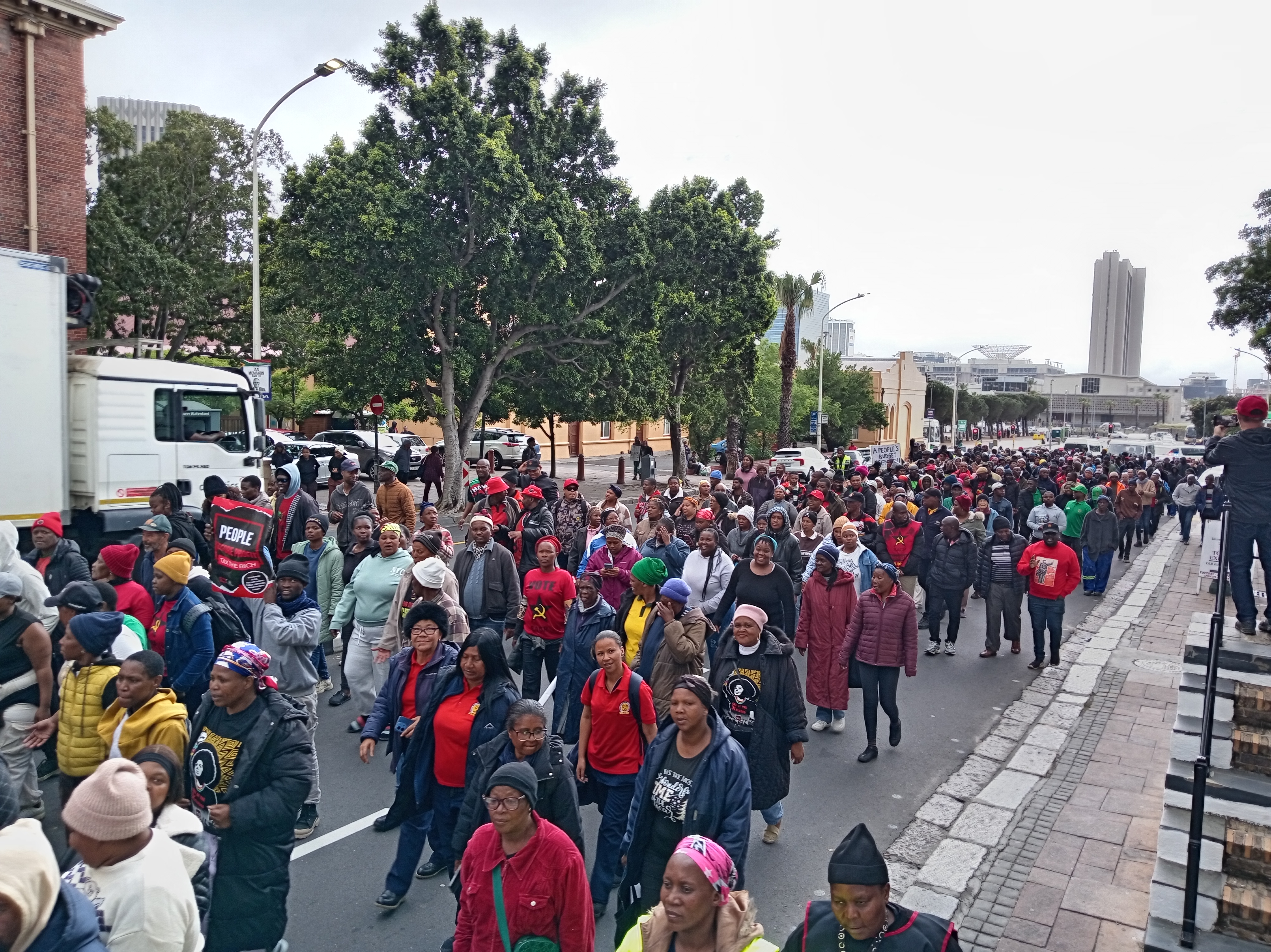
Activists went to Parliament on Wednesday to put forward demands ahead of Minister of Finance Enoch Godongwana’s mini-budget announcement. Photo: Abonge Chiya
The Social Relief of Distress (SRD) grant will be extended for another year, according to Minister of Finance Enoch Godongwana’s mini-budget announcement on Wednesday.
The grant was due to end in March 2027.
Meanwhile, the government will continue with its plan to integrate the grant with “labour market activation, skills development and enterprise support”. Beneficiaries will be linked to jobs, training and business opportunities through a new government data platform, MzansiXchange.
This platform will allow the government to check grant recipients against other public records to help identify duplicate and fraudulent claims.
In his Medium Term Budget Policy Statement (MTBPS) to Parliament on Wednesday, Godongwana made no mention of President Cyril Ramaphosa’s announcement in this year’s State of the Nation Address that the SRD grant would become permanent and be transformed into a “livelihoods” grant.
Godongwana had told reporters in February that the “finer details” of the SRD grant’s future would be announced during the MTBPS.
Instead, the MTBPS focused on verification measures and savings across the social grants system. The Treasury says enhanced biometric enrolment and beneficiary verification will lead to savings of R13.1-billion over the three years from 2027/8 to 2029/30. The same process is to be applied to the National Student Financial Aid Scheme (NSFAS) and housing subsidies next.
The number of social grant beneficiaries is expected to fall from 17.8-million in 2026/27 to 17.1-million by 2029/30. The Treasury expects this decline to save R6.2-billion, which will be redirected towards preventing violence against women and tackling child malnutrition and stunting. This includes R1.6-billion over the medium term to support pregnant women and young children through district health programmes.
The social assistance budget has been reduced from R292.8-billion to R289.8-billion in 2026/27. The allocation for the SRD grant has fallen from R36.9-billion in February’s budget to R35.6-billion because of fewer beneficiaries than expected.
In January 2025, the High Court ruled that provisions relating to the grant’s means-test threshold, value and income rules were invalid. The government appealed, and the Supreme Court of Appeal heard the case in August 2026. Judgment is still pending.
If the High Court ruling is upheld, between three million and 13 million more people could qualify for the grant. Treasury estimates that its annual cost could rise from about R36-billion to R74-billion.
Godongwana also announced further cuts to the fuel levy, to bring some relief to consumers.
He announced extra spending on fighting crime, especially against women, with R3.8-billion set aside to hire more than 3,500 social workers specifically to strengthen prevention “in response to rising murders and attacks on women”.
An additional R21.8-billion would be allocated to local government to cover the higher bulk costs of free basic water, sanitation, electricity and refuse removal. But Godongwana also reiterated plans to tie local government funding to delivery, and announced legal reforms to tighten up municipal and state spending.
Protests
Earlier in the day, about 500 activists marched to Parliament, calling on the minister to prioritise poor and working-class communities.
The groups marched under the banners of Cry the Xcluded and the Women on Farms Porject, the Congress of South African Trade Unions (COSATU) and the National Education, Health and Allied Workers’ Union (NEHAWU).
In a statement, COSATU called on the minister to fill vacancies for doctors, nurses, police, teachers and other essential workers, to “fix” local government, to ramp up the fight against crime, to reduce the “suffocatingly high” price of fuel and to adjust the SRD grant to take inflation into account, among other things.
Farm worker Engela van Schalkwyk said she had worked on a farm in the Hex River Valley since she was 14, and earns the minimum wage of R30.23 an hour, which she said is not enough. “Most of the time you can’t even buy enough food in the shops.”
Khayelitsha resident, 26-year-old Wonkuthalo Manyamalala, said she had been battling to find permanent work for six years. She said she barely survived on the R370-a-month SRD grant. “We want permanent jobs.”
“I wish that the government will increase the Old Age Grant as we support our families with this money,” said Delft pensioner Prince Msindo. “Our kids are sitting at home and can’t get jobs.”
In Pretoria, a coalition of trade unions, community organisations and civil society groups staged a picket outside the National Treasury offices, calling for increased spending on healthcare, education and housing, the expansion of public employment programmes, and a universal basic income guarantee.
It also called for expanded access to free basic services, greater funding to tackle gender-based violence and crime and progressive tax reforms, including a wealth tax on high-net-worth individuals.
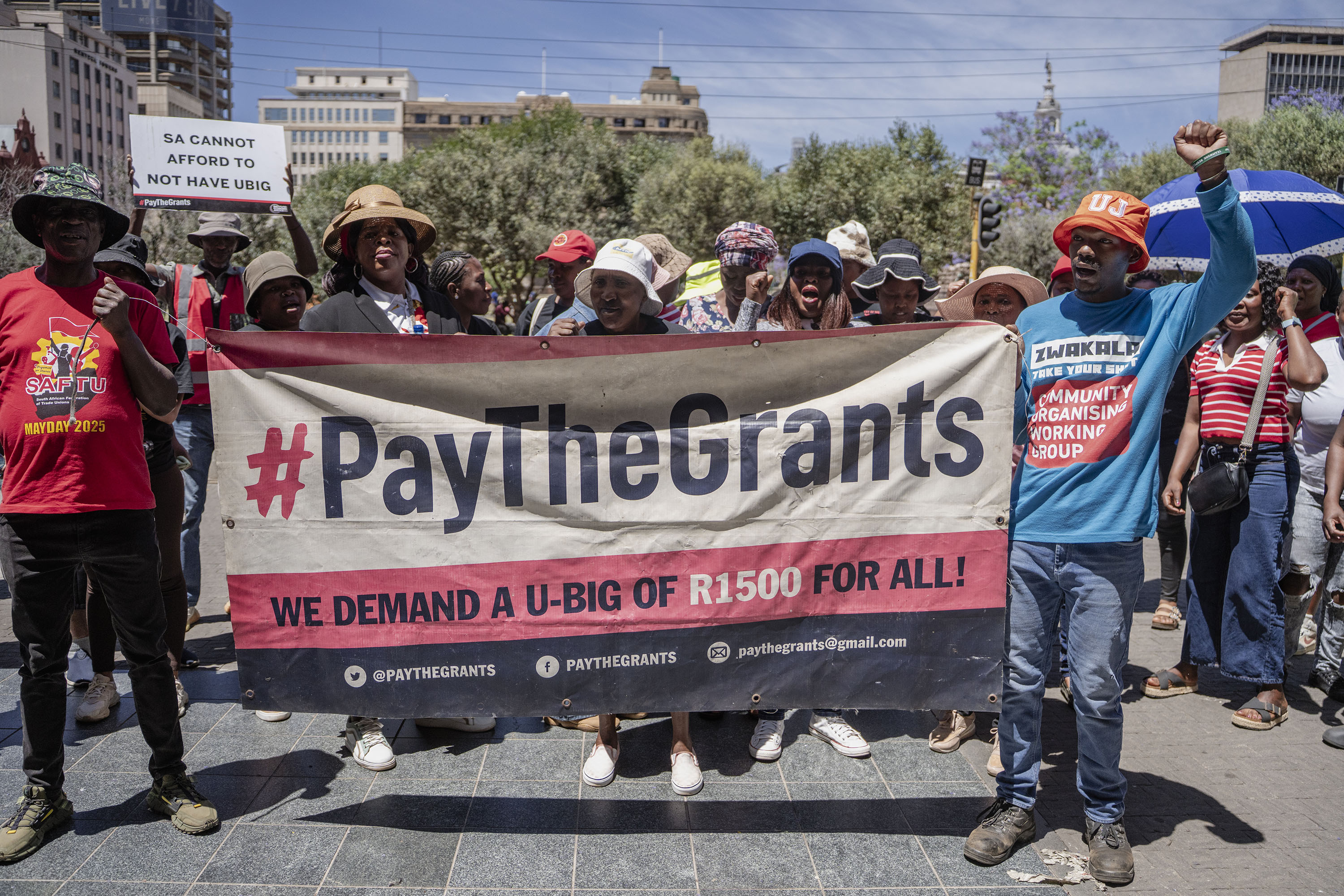
In Pretoria, activists called for a Universal Basic Income Grant. Photo: Ihsaan Haffejee
Support independent journalism
Donate using Payfast

Don't miss out on the latest news
We respect your privacy, and promise we won't spam you.
Previous: 10 key takeaways from the budget speech
© 2026 GroundUp. This article is published under the GroundUp Republication Licence Version 1.0. Email [email protected] to request permission to republish.