
Farm workers march to Parliament calling for land
“I want to create a better life for my children” says evicted farm woman
 Add GroundUp on Google
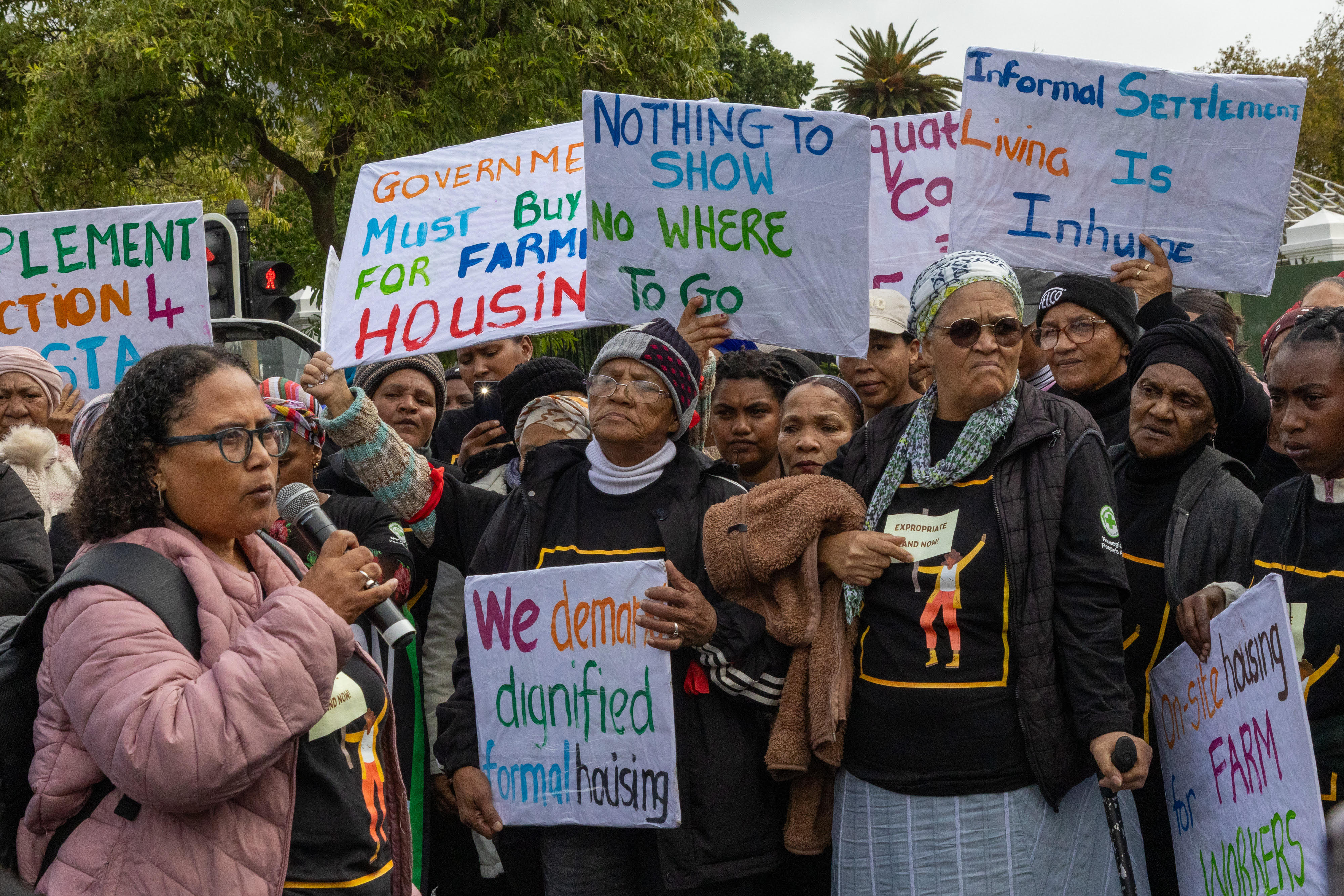
Carmen Louw, Women on Farms Project co-director, addressed farm women outside Parliament. Photo: Liezl Human
Over 100 farm workers and people living on farms, represented by Women on Farms Project (WFP), protested outside Parliament on Tuesday calling for the government to accelerate land redistribution for farm women.
The women were carrying placards reading “We demand dignified formal housing” and chanted “We want land”.
Outside Parliament, WFP director Colette Solomon handed over a memorandum to a representative of the Department of Land Reform and Rural Development.
She said that 32 years after democratic elections on 27 April 1994, farm workers today “are still facing eviction” even when they had worked on the farm “for generations”.
Farm workers and farm dwellers who are evicted are often displaced to “overcrowded informal settlements”, WFP said in their memo.

“I want to create a better life for my children,” said one of the protesters, Johanna August. She was evicted with 23 other families from a farm in Wellington in 2015 and now lives in an informal settlement called New Rest. Life is tough in New Rest, where there are frequent shack fires.
She said that she had lost her son in a fire.
“The life we live now is not the same as the farm life. Farm life was a lot better,” said August.
According to Carmen Louw, WFP co-director, the informal settlement has grown since the first few families were moved there. “Their conditions have just deteriorated,” said Louw.
She said communicable diseases such as tuberculosis are rife, waste piles up around people’s homes, and during rain the informal settlement floods.
Louw also said they are still seeing a lot of eviction cases on farms.
The memo called for a meeting with Minister of Rural Development and Land Reform Mzwanele Nyhontso, Minister of Public Works and Infrastructure Dean Macpherson, and and Minister of Agriculture John Steenhuisen to discuss issues of land redistribution, evictions, and food insecurity.
They also called on Nyhontso to implement “land redistribution legislation that prioritises farm women” and to “acquire and expropriate land for redistribution, starting with unused commercial farmland”.
Nyameko Mgoqi, acting chief director at the Department of Land Reform and Rural Development, came out to sign the memo and said he would communicate it to the other departments. He said government would respond.
Support independent journalism
Donate using Payfast

Don't miss out on the latest news
We respect your privacy, and promise we won't spam you.
Next: The need to grow food in informal settlements
Previous: Extortion threat hits rubbish collection in Cape Town
Letters
Dear Editor
The plight of farm workers must become a national crisis. The current legislation that prevents evictions from farms when you have lived for decades on a farm, helping to develop that farm, is completely inadequate.
Farm workers have suffered enormously under apartheid, and now in democracy, many of them struggle even more. They must be seen as co-farmers. They have all the skills and expertise to manage a farm. They are leaders in farming because of the exposure some farmers gave them.
Many of our farmers who have had the same farm workers for many decades on their farms have a moral obligation to empower farm workers, not just with decent housing, but also - like very few farmers do - to donate some of their land (e.g., 5 hectares) for farm workers to improve their income, dignity, and livelihood. We need to care, love, respect and invest in each other. Farmers need to be frontrunners to show authorities what Ubuntu is and how we should empower farm workers rather than discriminate.
Dear Editor
It is unconscionable that, 32 years into democracy, farmworkers, especially women, continue to suffer under the weight of underdevelopment, racial supremacy, illegal evictions, and systemic abuse. The brutal practice of being kicked off a farm by a “baas van die plaas” is not only a violation of human rights, it is a direct assault on dignity and the hope of 1994.
This struggle is bigger than wages or work, it is about restoring humanity, uplifting communities, and breaking the chains of generational oppression. Children of farmworkers should inherit hope, education, and opportunity, not stereotypes of incompetence imposed by a toxic system designed to keep them marginalised.
Farms must be transformed into institutions of growth, learning, and mentorship - places where workers and their families thrive, not where they are trapped in cycles of poverty and despair. Instead, too many farms have become graveyards of potential, stagnant spaces of hopelessness. This is unacceptable.
We must demand accountability. We must insist that land and labour serve justice, not exploitation. We must fight for policies and practices that restore dignity, empower women, and create pathways for children to rise beyond the limitations imposed on their parents. The future of democracy depends on whether we dismantle these structures of supremacy and replace them with communities of hope, equity, and flourishing.
© 2026 GroundUp. This article is published under the GroundUp Republication Licence Version 1.0. Email [email protected] to request permission to republish.